
Why Coastal Entry Doors Are the Primary Envelope Failure Point
Along South Florida and exposed coastal corridors, entry doors face relentless mechanical stress whenever tropical cyclones make landfall. Unlike static masonry or concrete shear walls, an exterior door is a dynamic assembly of slabs, perimeter seals, hardware, and structural anchors. When gale-force gusts collide with windborne debris, weak jambs and hollow residential cores become immediate breach points that allow destructive internal pressurization.
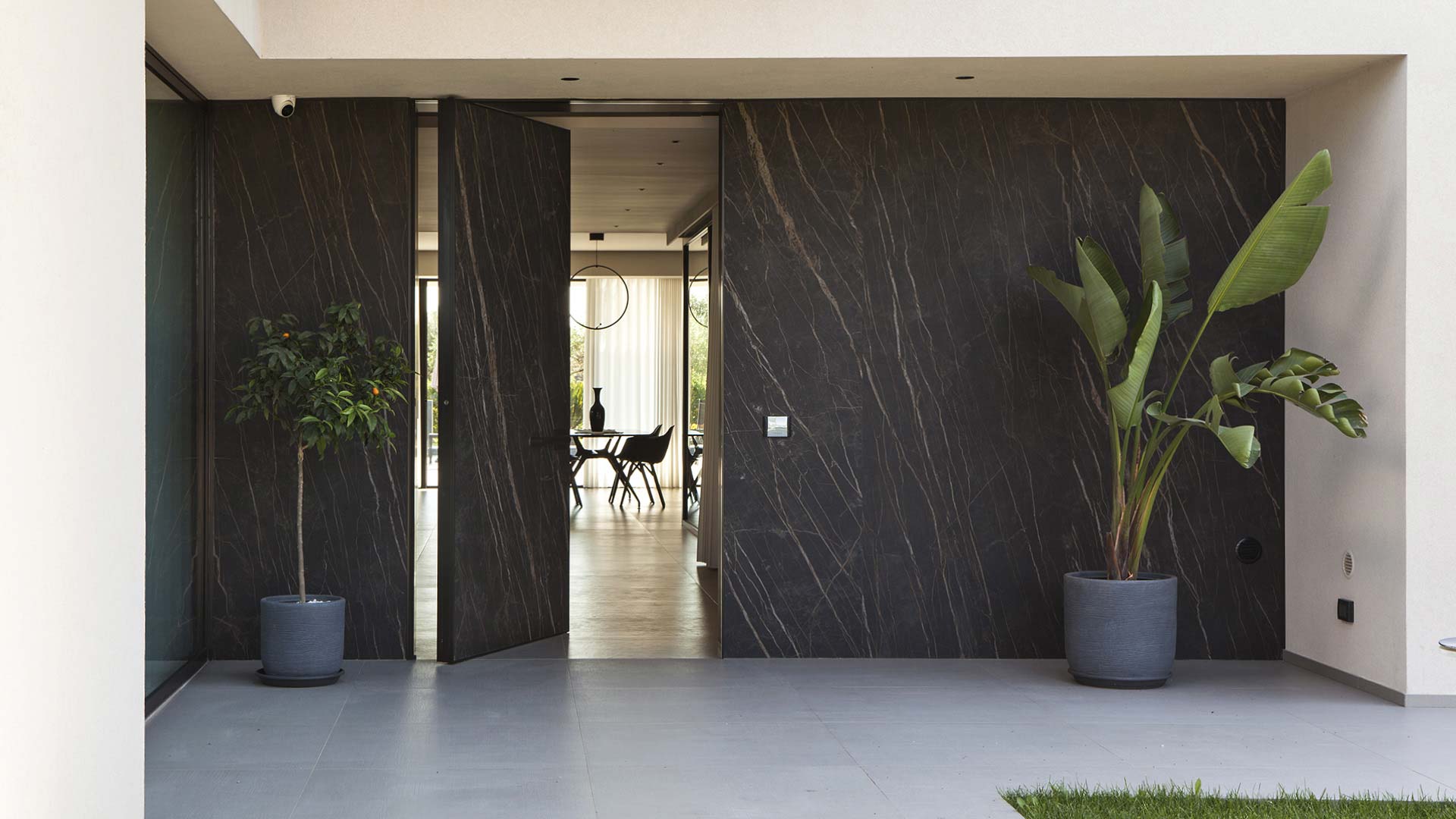
Don't let the breathtaking beauty fool you — behind every bespoke finish is serious, high-level structural security. Featuring Oikos Security Doors crafted with handmade Italian precision, modern architectural entries pair gallery-grade wood, porcelain, or stone claddings with concealed heavy-gauge steel armor and multi-point locking bolts engineered to hold fast under extreme storm loads.
- Movable perimeter joints, latching hardware, and laminated glass inserts represent the highest-risk vulnerability in coastal facades.
- Internal structural pressurization following an exterior door breach can lift roof framing and compromise the entire building envelope.
- Armored steel cores prevent racking, deflection, and latch pull-out under sustained cyclonic gusts.
Three-Part Impact, Air, and Water Certification Testing
True coastal compliance under Florida Building Code and Miami-Dade High Velocity Hurricane Zone (HVHZ) Notice of Acceptance (NOA) protocols is never a marketing label. Laboratories subject full-scale door assemblies—including frames, thresholds, and multi-point bolts—to three distinct failure simulations before granting certification.
First, large-missile and small-missile impact tests fire heavy structural lumber and high-velocity steel projectiles directly at the door slab and any laminated glazing inserts. Immediately afterward, the tested assembly endures thousands of positive and negative pressure cycles simulating inward gusts and outward suction. Finally, pressurized water-infiltration chambers verify that threshold sweeps and perimeter gaskets block wind-driven rain.
- Large-missile impact testing replicates heavy storm debris striking ground-level entries without structural penetration.
- Cyclic positive and negative wind-load testing verifies anchor retention, frame rigidity, and multi-point bolt engagement.
- Pressurized water testing confirms continuous perimeter gaskets and drop-down threshold seals keep interior floors dry.
Engineering Hurricane-Certified Pivot Doors Without Compromising Scale
Oversized pivot entries present a specialized engineering challenge compared with standard hinged doors. Because a pivot leaf rotates around top and bottom axis bearings rather than side jamb hinges, the vertical gaps at the pivot edge cannot be obstructed by conventional continuous weatherstripping. Traditional solutions force architects to add recessed trench drains or deep exterior overhangs proportional to the door height.
Through advanced perimeter gasket geometry, reinforced thermally broken steel subframes, and precision-machined pivot assemblies, modern armored pivot doors achieve Miami-Dade HVHZ NOA compliance at grand architectural heights. Paired with laminated impact-rated glass inserts and optional UL 120 fire-rated assemblies where code dictates, these entries preserve clean facade lines without sacrificing coastal resilience.
- Heavy-gauge steel internal skeletons support towering door slabs and thick stone or wood veneers without hinge sag.
- Concealed multi-point locking bolts anchor the leading edge, top header, and bottom sill simultaneously against storm suction.
- Drainage coordination or portico depth should be reviewed early in schematic design to protect threshold seals.
Why Certified Hurricane Protection Differs From Forced-Entry Security
Homeowners often use the phrase 'hurricane-proof,' yet experienced coastal engineers reject that term. Building codes establish rigorous design-pressure thresholds—such as ±65 PSF Large and Small Missile Impact (LMI) design pressure under Miami-Dade NOA 23-1012.17 (Pivot) and NOA 23-1012.18 (Hinged)—while acknowledging that extreme roof loss or improper installation compromises any opening. Certification proves a door system survived standardized laboratory extremes when anchored to an approved substrate.
Equally critical is recognizing that storm certification alone does not equal dedicated burglary resistance. A standard impact door resists random flying debris, whereas a determined intruder applies concentrated leverage, drilling, and targeted strikes at lock cylinders. Integrating Oikos Security Doors engineered with hardened anti-drill plates, multi-point steel bolts, and concealed steel armor closes both the weather and forced-entry gaps in a single architectural specification.
- Impact certification addresses wind pressure and storm debris; forced-entry armor defends against prying, kicking, and cylinder attack.
- Independent third-party accreditation and Miami-Dade HVHZ NOA verification protect project permitting and insurance underwriting.
- UL 120 fire-rated configurations are available for interior garage transitions, mechanical rooms, and multi-family corridors.
Installation Precision and Coastal Salt-Spray Stewardship
Even the strongest laboratory-tested assembly fails if site contractors shim frames improperly, omit structural concrete anchors, or break perimeter sealant continuity. Coastal installations require strict adherence to approved fastener schedules, plumb subframe alignment, and marine-grade corrosion protection across exposed stainless hardware and sills.
DVJ Consulting LLC coordinates directly with architects, structural engineers, and general contractors so rough openings, electrical conduits for motorized smart-lock technology, and threshold waterproofing align before delivery. Annual inspection of perimeter gaskets, threshold sweeps, and salt-exposed finishes keeps coastal security doors performing smoothly across decades of hurricane seasons.
- Verify structural anchor spacing and substrate compressive strength prior to setting the steel subframe.
- Specify marine-grade hardware finishes and periodic fresh-water rinsing in direct salt-spray environments.
- Schedule routine seal and multi-point bolt alignment checks before peak storm months.