
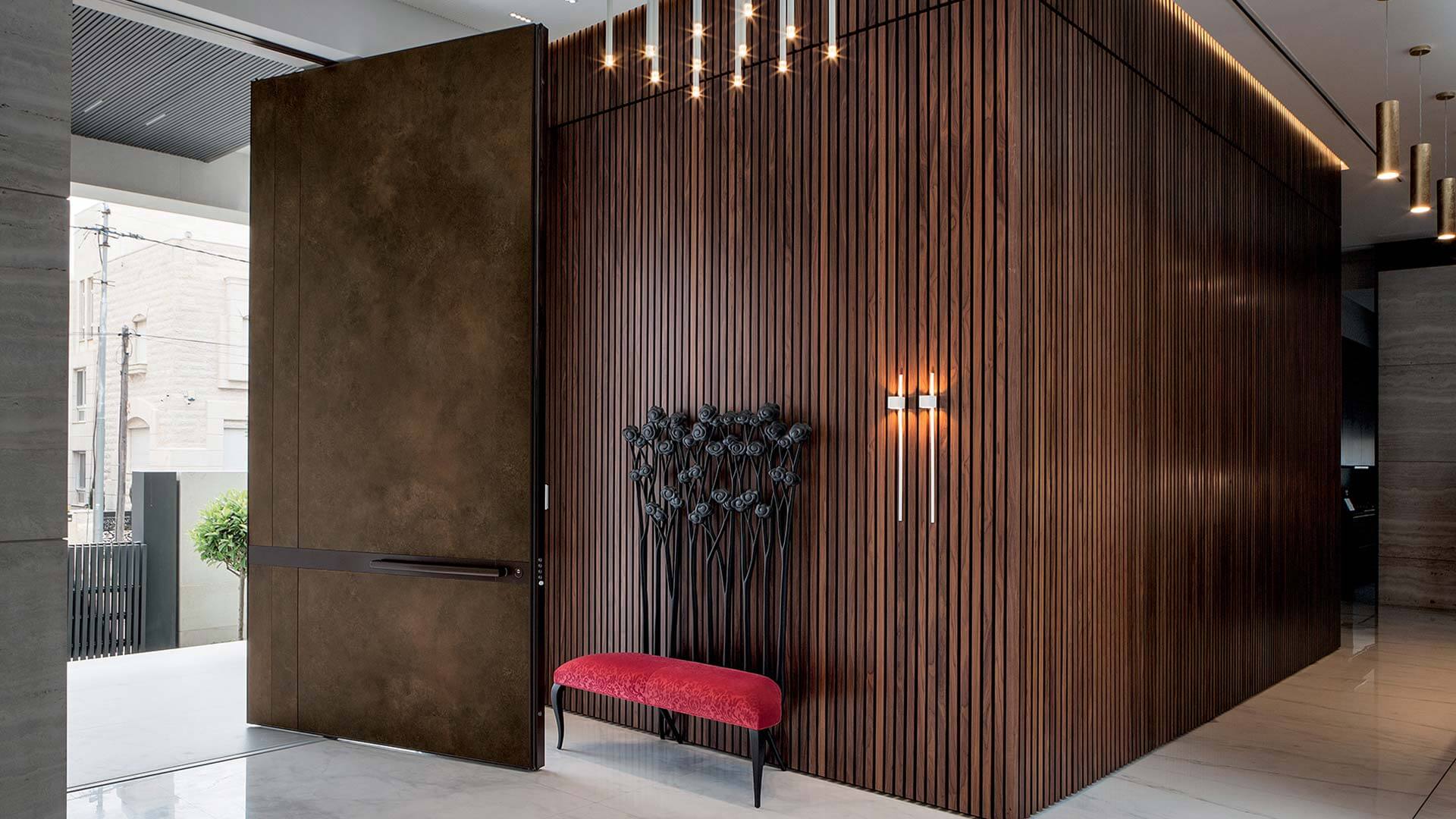
Why Luxury Estates Face Distinct Architectural Security Challenges
Securing a 12,000-square-foot residence differs fundamentally from outfitting a standard suburban house. Luxury estates feature expansive entry openings, multiple terrace portals, long sightlines, and valuable collections—combined with high-profile residents who value privacy above all else.
Unfortunately, many property owners encounter two discouraging extremes: utilitarian steel grates that ruin carefully curated facades, or decorative wood doors equipped only with basic alarms and cameras. True architectural security door specialists bridge both disciplines, embedding concealed heavy-gauge steel armor inside custom Italian finishes so protection enhances rather than disrupts residential architecture.
- Expansive floor plans and secluded grounds require physical perimeter hardening, not just passive motion alerts.
- Bespoke security doors preserve sightlines and facade symmetry without unsightly exterior bars or vault plates.
- Discreet interior protection allows master suites and private studies to match standard millwork invisibly.
The Risks of Buying Security Doors From Safe Dealers or A/V Integrators
Because luxury estates employ numerous specialty trades, homeowners frequently receive well-meaning pitches from adjacent vendors. Floor-safe dealers often offer bolt-on iron grilles or industrial vault doors as front entries, while audio-visual contractors sometimes bundle generic commercial doors alongside camera packages.
Neither discipline possesses deep expertise in architectural thermal breaks, multi-point residential bolt geometry, Miami-Dade HVHZ NOA wind-load anchoring, or handmade Italian finish fabrication. Worse, alarm-centric contractors often push expensive monthly monitoring plans that notify dispatchers only after a weak timber door has already been kicked open.
- Safe installers specialize in anchored steel boxes, not weather-sealed architectural facades or custom wood veneers.
- A/V integrators excel at low-voltage media networks rather than structural door framing and forced-entry metallurgy.
- Physical door armor stops intrusion at the threshold rather than merely filming a breach in progress.
Overcoming 'Enormity Paralysis' Through Calibrated Threat Assessment
When bespoke fabrication offers limitless combinations of natural stone, hardwood, porcelain, glass, and metal, decision fatigue—often called enormity paralysis—can stall project schedules. Equally common is unnecessary over-specification: clients hear about ballistic glass or heavy military-grade armor and assume every interior door requires maximum rating.
Reputable specialists work collaboratively with your architect, interior designer, and personal protection advisors to calibrate threat levels accurately. A primary coastal entry may demand Miami-Dade HVHZ NOA impact performance alongside high forced-entry ratings, while a garage transition prioritizes UL 120 fire certification and a private bedroom relies on acoustic steel armor and biometric access.
- Threat-proportional engineering prevents wasted budget on unneeded ballistic specs where forced-entry armor excels.
- Curated material palettes narrow finish choices to complement existing marble, timber, and architectural metals.
- Design continuity ensures fortified doors integrate cleanly with surrounding standard interior openings.
Evaluating Technical Integration, Privacy, and Project Delivery
Before selecting a partner, verify how they coordinate structural subframes, electrical rough-ins, and cybersecurity. Motorized smart-lock technology, biometric fingerprint verification, and automated climate/lighting triggers require tight collaboration between door engineers and licensed home-automation integrators—without exposing lock controls to vulnerable public networks.
DVJ Consulting LLC serves as a dedicated architectural division featuring Oikos Security Doors, guiding residential design teams from initial specification and structural subframe tolerances through handmade Italian fabrication and site coordination. By uniting vetted engineering, certified hurricane and fire performance, and discreet client confidentiality, specialists deliver enduring security wrapped in unmistakable beauty.
- Confirm proven coordination workflows for structural subframes, dry-contact smart-home control wiring, and dedicated 12V/24V lock power.
- Ask for documented test standards—such as Miami-Dade HVHZ NOA and UL 120—rather than vague marketing claims.
- Prioritize partners who protect client confidentiality and project drawings throughout procurement.
Questions to Ask Before Commissioning Custom Armored Doors
During initial consultations, savvy homeowners and architects ask penetrating engineering questions that quickly separate true specialists from decorative millwork brokers. Request cross-sectional CAD drawings showing internal heavy-gauge steel thickness, thermally broken framing barriers, multi-point steel bolt throw depths, and how exterior Italian claddings attach mechanically without compromising structural armor.
Additionally, verify post-installation service protocols, spare electronic control module availability, and mechanical key-override behavior during extended power outages or storm emergencies. A qualified architectural security partner provides transparent shop drawings, clear fabrication milestones, and dedicated technical support so your doors remain effortless, quiet, and dependable for decades.
- Inspect cross-section details for heavy-gauge steel framing, insulated infill, and concealed bolt receivers.
- Verify mechanical key-cylinder override operation independent of battery, Wi-Fi, or grid power.
- Confirm factory-built steel subframe availability to protect rough-opening tolerances during construction.