
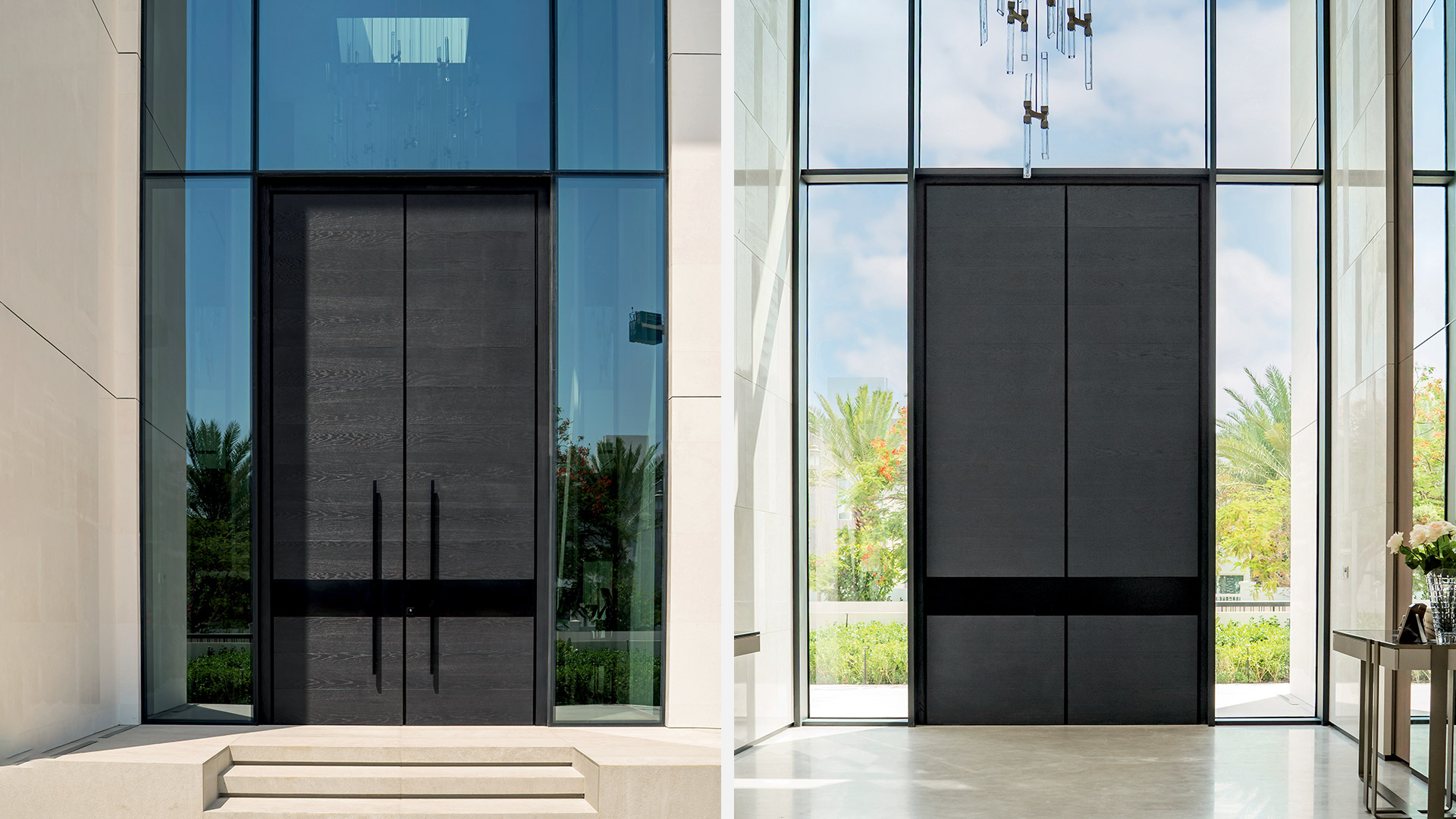
Overcoming the Historic Weakness of Center-Meeting Doors
Security specialists have long cautioned homeowners against standard residential double doors, and for good reason. In conventional millwork, one leaf relies on lightweight surface flush bolts into a wooden header and sill, while the active leaf latches into the passive leaf with a single short deadbolt. Under prying leverage or blunt impact along the center astragal, timber jambs split and superficial pins shear away in seconds.
Modern architectural engineering eliminates that compromise entirely. Featuring Oikos Security Doors, high-security double configurations replace hollow wood stiles and surface latches with unified, concealed heavy-gauge steel armor inside every leaf and a rigid structural steel subframe anchored deep into surrounding masonry or concrete. Don't let the breathtaking beauty fool you — behind every bespoke finish is serious, high-level structural security.
- Internal heavy-gauge steel chassis resists prying, kicking, and torsional flexing across wide dual-leaf spans.
- Reinforced interlocking center astragals shield the meeting stile from pry-bar insertion and wedge attacks.
- Deep structural subframes distribute impact forces into the building envelope rather than brittle trim casings.
- Tamper-resistant concealed Hinged Doors hardware keeps hinge pins completely inaccessible from the exterior.
Synchronized Multi-Point Locking Across Active and Passive Leaves
True double-door fortification depends on securing both panels with equal structural authority. Instead of treating the secondary leaf as an afterthought, engineered armored double doors drive heavy steel locking bolts simultaneously into the head, threshold, and outer jambs. When the active leaf engages, hardened deadbolts lock horizontally into the reinforced passive stile while vertical rods anchor directly into steel receivers embedded in the floor and header.
Motorized smart-lock technology elevates both convenience and discipline. Every time the active panel closes, automated mechanisms throw the primary locking bolts without requiring manual turns or remembered deadbolt checks. Homeowners gain seamless keyless entry via encrypted credentials, wall-mounted biometrics, or mobile oversight while ensuring neither leaf is ever left unlatched.
- Multi-point locking bolts secure top, bottom, and lateral edges of both active and passive door leaves.
- Hardened drill-resistant cylinder guards protect core lock mechanics from mechanical extraction or picking.
- Motorized auto-locking engages full deadbolt throw automatically upon closure to eliminate human oversight.
- Manual release overrides guarantee rapid, code-compliant egress from the interior during emergencies.
Single, Double, and Arched Configurations for Every Wing
Symmetrical double doors bring unmistakable architectural rhythm to grand foyers, garden loggias, and primary bedroom suites. Beyond rectangular openings, Italian custom fabrication adapts armored steel geometry to arched transoms, curved masonry portals, and multi-bay terrace sequences overlooking pool decks. Each configuration preserves clean architectural lines whether installed on exterior facades or interior suite boundaries.
For homeowners who admire double-leaf proportions yet want uninterrupted glass sightlines, structural steel frames pair effortlessly with multi-layer laminated glass panels. Natural daylight floods entry galleries and rear courtyards while tested impact glazing resists forced entry, acoustic transmission, and extreme storm pressures.
- Bespoke arched top profiles integrate cleanly into Mediterranean, classical, and transitional facades.
- Inward-swinging bedroom double doors protect interior suites while keeping all mechanical hardware on the secure side.
- Acoustic and thermal perimeter seals reduce conditioned-air loss, exterior street noise, and dust infiltration.
- UL 120 fire-rated hinged options and project-specific structural submittals adapt double doors to regional codes (while Miami-Dade NOAs 23-1012.17 and 23-1012.18 cover single-leaf Pivot and Hinged assemblies).
Specifying Hardware, Swings, and Finishes Without Trade-Offs
Planning a high-security double door begins with careful attention to traffic flow, swing clearance, and environmental exposure. Architects verify that inward or outward swing arcs clear adjacent furniture, staircases, and lighting sconces, while threshold profiles account for interior stone flooring and exterior drainage slopes. Choosing between traditional Hinged Doors and contemporary wide-span pivot alternatives depends on both structural spans and desired visual drama.
Once mechanics and clearances are locked in, bespoke finishes transform the fortified steel assembly into an heirloom architectural feature. From hand-selected oak and sintered stone on exterior facades to refined lacquer, glass, or leather inside a dressing suite, handmade Italian craftsmanship ensures symmetrical beauty matches unyielding strength.
- Verify clear swing arcs against cabinetry, stone steps, and ceiling pendant heights before finalizing hinge handing.
- Match exterior finishes to UV and moisture exposure while tailoring interior faces to room decor.
- Specify architectural pull bars and levers engineered to handle substantial armored leaf weight smoothly.
- Partner with experienced technical consultants early to coordinate steel subframe anchoring and finish schedules.