
The Structural Reality Behind Conventional Wood Doors
Walk through most residential neighborhoods and you will find two categories of wood doors: lightweight hollow-core interior slabs filled with cardboard honeycomb, and traditional solid-wood exterior doors milled from thick timber stiles and rails. While solid hardwood feels reassuringly substantial compared to hollow-core construction, wood as a standalone structural barrier has inherent mechanical vulnerabilities.
Under concentrated force from a crowbar, hydraulic spreader, or heavy kick near the latch mortise, timber fibers split along the grain. Furthermore, seasonal humidity swings cause unarmored wood frames to swell, shrink, and twist, gradually misaligning deadbolts and weakening latch engagement. For affluent homeowners who want authentic wood aesthetics without those structural liabilities, the answer lies in decoupling the visible surface from the load-bearing core.
- Natural timber grains split easily around standard lock mortises under forced prying
- Moisture absorption causes seasonal expansion and deadbolt binding in unreinforced slabs
- Conventional wood jambs often lack deep structural anchoring into surrounding masonry
- Hollow-core interior doors offer virtually zero delay against determined physical intrusion
Steel-Armored Timber: Real Wood Beauty Over a Welded Chassis
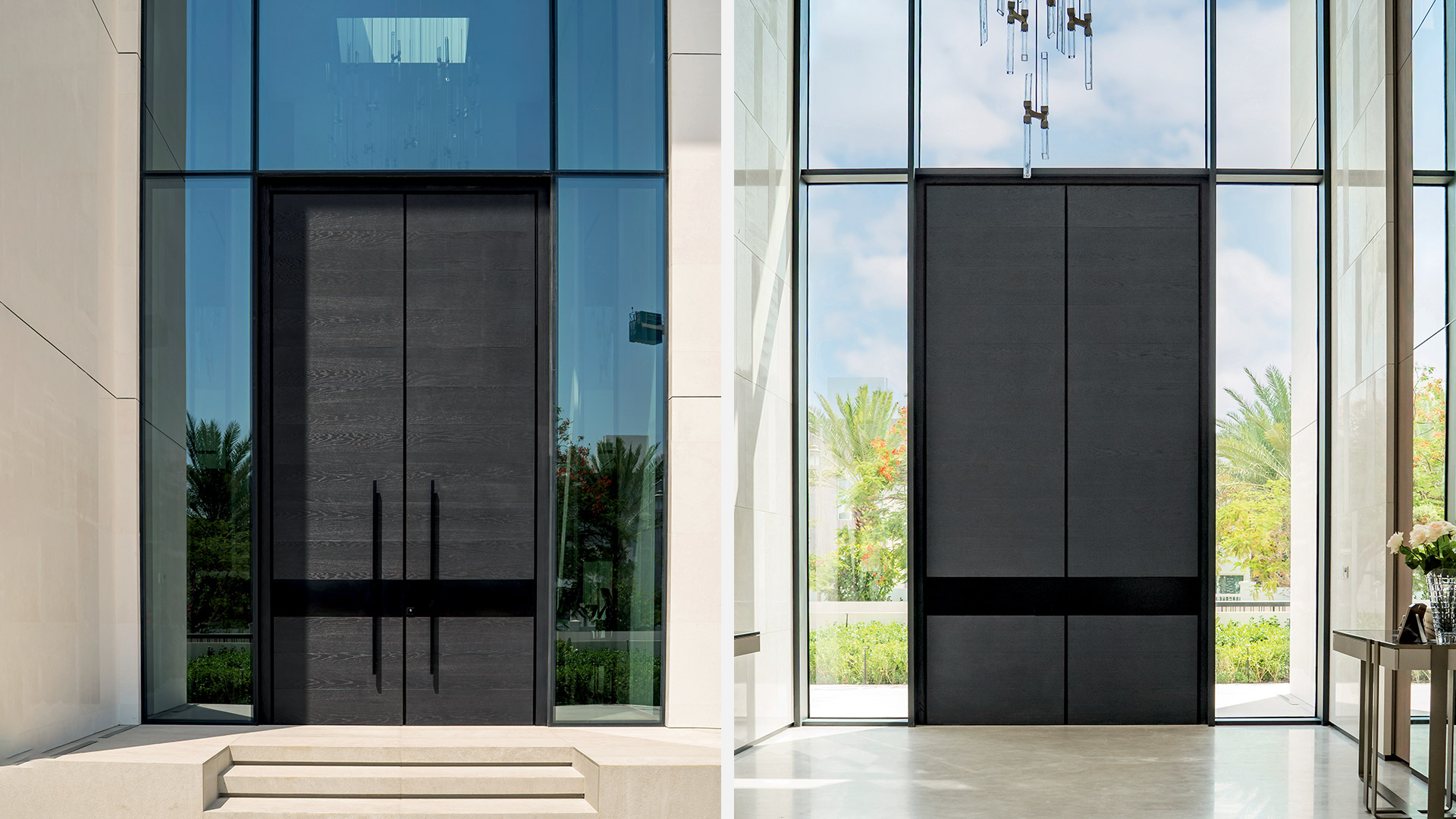
Don't let the breathtaking beauty fool you — behind every bespoke finish is serious, high-level structural security. Rather than painting steel to mimic timber grain, Featuring Oikos Security Doors begin with a heavy-gauge steel internal frame and reinforced leaf structure. Precision-milled natural wood veneers, thick solid timber planks, or weather-stable engineered wood panels are then mounted as architectural cladding over that concealed armor.
Because the steel skeleton absorbs all torsional stress, thermal movement, and forced-entry loads, the wood surface never bears structural responsibility. Multi-point steel locking bolts shoot deep into a reinforced steel sub-frame, while anti-jemmy hinges or heavy-duty pivot assemblies prevent the leaf from being levered off its mounts.
- Heavy-gauge galvanized steel core resists cutting, prying, and blunt-force impact
- Multi-point locking bolts secure top, bottom, and latch edges simultaneously
- Dimensionally stable chassis prevents the seasonal warping common to all-wood doors
- Handmade Italian craftsmanship delivers crisp joinery and seamless hardware reveals
Selecting the Right Wood Cladding for Climate and Exposure
Exterior doors face relentless environmental challenges—ultraviolet radiation, driving rain, salt spray, and rapid temperature shifts. Specifying raw solid wood on an unprotected southern or western elevation invites premature finish degradation. Experienced architectural consultants evaluate overhang depth, wind orientation, and regional humidity before recommending the optimal wood treatment.
When full exterior exposure makes solid hardwood impractical, high-stability engineered wood composites, marine-treated veneers, or wood-textured porcelain stoneware provide remarkable longevity with minimal upkeep. Crucially, dual-face cladding allows homeowners to pair rugged, weather-hardened materials outside with rich custom-stained walnut, oak, or okoume on the protected interior face.
- Custom stain matching to harmonize with existing architectural millwork and flooring
- Dual-finish capability enables weather-resistant exterior cladding with warm interior hardwood
- Marine-grade and UV-stabilized engineered wood options for high-humidity or coastal sites
- Independent panel mounting allows future refinishing without disturbing the security core
Adding Security Glazing and Smart Hardware Without Breaking Style
Many homeowners with wood-clad entries want daylight filtering into the foyer or discreet sightlines toward the driveway. Integrating multi-layered laminated security glazing directly into a timber-clad steel door achieves transparency without creating a weak breach point. Frosted, smoked, or custom-etched interlayers maintain daytime privacy while preserving architectural continuity.
Smart-lock technology completes the ensemble cleanly. Concealed motorized locks, encrypted keypads, and biometric readers can be recessed into the wood reveal or adjacent jamb so there are no clunky retrofitted cylinders cluttering the grain. In consultation with DVJ Consulting LLC, residential designers achieve the timeless character of fine woodworking backed by certified structural resilience.
- Laminated security glass inserts engineered to resist impact and thermal stress
- Motorized smart-lock technology with automatic deadbolting upon door closure
- Flush hardware integration that preserves uninterrupted wood-grain aesthetics
- Optional fire-rated and hurricane-certified assemblies concealed beneath timber veneers
Acoustic Calm, Thermal Insulation, and Long-Term Timber Care
Beyond physical resistance, steel-core wood security doors dramatically outperform traditional solid-slab doors in indoor environmental quality. Dense internal mineral insulation paired with double- or triple-contact perimeter gaskets creates an acoustic barrier that hushes traffic, pool equipment, and neighboring street noise while preventing conditioned indoor air from leaking around the jamb.
Even maintenance becomes simpler over the decades. Because exterior wood panels attach cleanly to the steel chassis as serviceable cladding rather than structural glue-ups, owners can refresh protective UV topcoats or swap exterior wood species years later without ever touching the underlying locks, hinges, or structural steel frame.
- High-density core insulation delivers measurable acoustic and thermal performance
- Multi-perimeter EPDM gaskets seal out drafts, dust, humidity, and exterior noise
- Serviceable timber panels can be maintained or replaced independently of the steel chassis
- Eliminates the sticking, swelling, and lock-binding common in unarmored coastal wood doors